Budgeting
How to Make a Budget in Excel (Step by Step)
Build a budget in Excel from a blank sheet in about 20 minutes, with the exact formulas that add it up for you. Or skip ahead and grab our free template.

Co-Founder & CEO
Nate Stavseth is the co-founder and CEO of HappyBuck, and a financial copywriter who has spent nearly a decade turning complex money topics into clear, compelling writing that people actually read. Holding a dual degree in Marketing and International Business & Economics, he’s worked in the financial space since 2016, helping grow multiple trading and investing newsletters and digital products. His copy has driven over $100 million in revenue, the result of pairing marketing instinct with real economic grounding, writing about money in a way that’s practical, straightforward, and focused on what readers need to make confident decisions. Today he leads HappyBuck day to day, keeping the site’s guidance clear, honest, and genuinely useful.
Build a budget in Excel from a blank sheet in about 20 minutes, with the exact formulas that add it up for you. Or skip ahead and grab our free template.
Build a free, auto-saving budget in Google Sheets you can edit from your phone, with the exact formulas and a template you can copy in seconds.
Zero-based budgeting gives every dollar a job until nothing is left unassigned. Here is how it works, who it suits, and how to start your own.
A simple system for budgeting when your pay changes every month: set a baseline off your lean months, pay yourself a steady paycheck, and put the good months to work.
A sinking fund saves up for a known expense a little at a time, so the bill never blows up your month. Here is the simple math, 20 categories, and how to start.
Cash stuffing splits your spending money into labeled envelopes so when one is empty, you stop. Here is how to do it, which categories to use, and the real downsides.
The three most popular budgeting methods, compared side by side. See how 50/30/20, zero-based, and envelope budgeting differ, and which one fits how your brain works.
A realistic plan to break the cycle: why a missing buffer keeps you stuck, and the seven steps that get you a month ahead of your bills for good.
Pay yourself first flips the math: save before you spend, not with whatever is left. Here is how reverse budgeting works, how much to save, and how to automate it.
The trick to tracking spending is not the app, it is friction. Pick the easiest method you will keep, run a 30-day audit, then go light-touch. Here is how.
There is no single right way to budget as a couple. Here are the three common setups, how to split expenses fairly, and the one habit that matters more than the method.
An emergency fund keeps a surprise from becoming debt. Here is how much you need, how to build it without straining your budget, and where to keep it.
A high-yield savings account can pay 10x a regular savings account, with the same FDIC safety. Here is how they work, whether they are safe, and when one is worth it.
The common benchmarks say 1x your salary by 30 and 3x by 40. Here is what those mean, what people actually have saved, and why your own trajectory matters more.
You can cut your grocery bill without clipping a single coupon. Here are the tactics that move the number, from meal planning to store brands to wasting less.
A good savings challenge turns saving into a game with a finish line. Here is how the no-spend, 52-week, and 100-envelope challenges work and how to pick the right one.
Your fixed monthly bills are where the biggest, easiest savings hide. Here is which bills you can negotiate, the script that works, and how one phone call pays off.
Saving on a low income is not about willpower, it is about tiny, automatic habits and a clear-eyed view of the limits. Here is how to start, even when it feels impossible.
You can have a credit score in about six months, but a good one takes longer, and mine actually dropped first. Here is the real timeline, from someone who fumbled it early.
The snowball pays your smallest balance first for momentum. The avalanche pays your highest rate first to save the most money. Here is how each works and which to pick.
Credit card debt is the most expensive kind, and minimum payments are designed to keep you in it. Here is how to pay it off, and keep it gone.
Not all debt is created equal. Some builds your future, some just drains it. Here is how to tell good debt from bad, plus the reality that context matters more than the label.
A 0% balance transfer can save you real money on credit card debt, or trap you deeper if you use it wrong. Here is exactly how they work and the catch to watch for.
Debt consolidation rolls several debts into one payment, ideally at a lower rate. It can help, or quietly make things worse. Here is how to tell the difference.
Student loans are usually low-rate, which changes the strategy. Here is how to pay them off smartly, why crushing them fast is not always the right move, and the one rule that is.
Paying off debt on a tight income is slow, not impossible. Here is a realistic plan: protect your minimums, free up small amounts, attack one debt, and get real help.
Save or pay off debt first? The answer is a little of both, in order. Here is the sequence that keeps a surprise from undoing your debt progress.
The average credit score rises with every generation, but not because older people are better with money. Here is the by-age breakdown, and why the gap is mostly about time.
Credit Karma is not lying to you, but it is not showing the number your lender sees either. Here is why my scores never matched, and which one counts.
You do not need a portfolio or permission to start freelancing. You need one skill and one paying client. Here is exactly how to get both, from someone whose freelance gig became a career.
Freelance writing can pay a little or a lot, and the difference is what you write and who you write it for. Here is how to become a writer who gets paid well, from a decade in the trade.
The most reliable side hustles are not online. They are the local, hands-on ones people always need done. Here are the service hustles that pay cash, and how I used one to fund my real dream.
Businesses will pay well for someone who can bring them customers. Here is how to turn ad and content skills into a freelance income, from someone who has managed spend across every major platform.
The part every side-hustle guide skips: nobody withholds taxes from your gig income, and the bill is bigger than you think. Here is exactly how much to set aside so tax season is not a disaster.
Most "best side hustle" lists are padded with junk nobody actually makes money on. Here is an honest ranking by effort, pay, and startup cost, from real experience, plus the ones to skip.
Almost all "passive income" is neither passive nor income, at least not at first. Here is the plain breakdown of what works, what is a scam, and why I can spot the difference.
Forget the "$10k a month in your sleep" screenshots. Here are honest, realistic numbers for what different side hustles pay, and what separates a $200 month from a $2,000 one.
Some side hustles are meant to stay small. Others quietly become your career. Here is how to know the difference and make the leap safely, from someone whose side gig became his job.
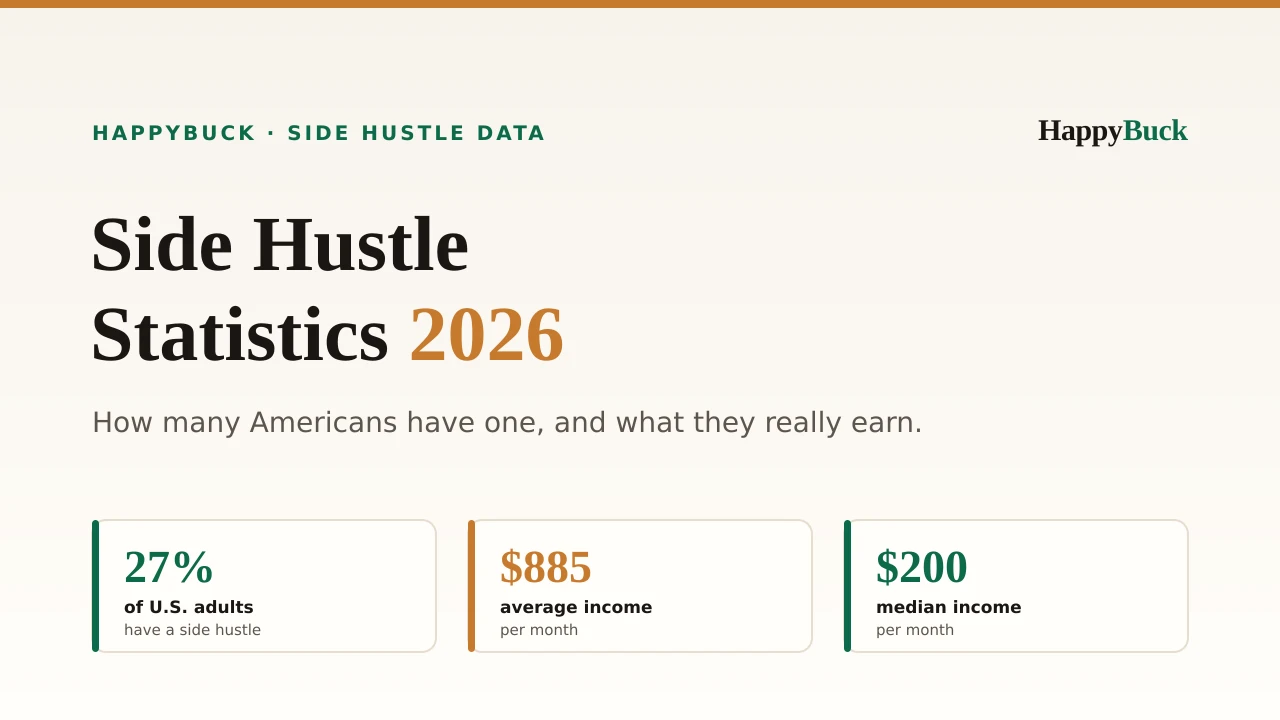
The latest national data on side hustles: how many Americans have one, what they really earn (the average is misleading), why they do it, and how earnings break down by generation.
A good credit score is 670 or higher, but "good enough" depends on what you are trying to do. Here is what each level unlocks, and why you rarely need a perfect score.
A FICO score is the credit score most lenders pull, built from your credit report on a 300-to-850 scale. Here is what it is, how it differs from other scores, and why it matters.
Credit scores run from 300 to 850, split into five bands from poor to exceptional. Here is what each range means, where the important cutoffs are, and how FICO and VantageScore compare.
The best time to start building credit is the day you turn 18. Here is what I wish I had done, what works for students, and how I am giving my own kids a head start.
A secured credit card is basically a debit card that builds credit. You fund it like a deposit, use it normally, and quietly build history. Here is how they work and how to use one right.
A credit report error tanked my score through no fault of my own, and I did not fight it. Here is exactly how to dispute an error the right way, for free, so you do not make my mistake.
I carry an Amex Platinum and like it, but I would not recommend it to most people. Whether a premium rewards card is worth the fee comes down to one honest question about you.
When you work for yourself, no one sets up your retirement or explains the options. Here is the self-employed playbook, SEP IRA vs solo 401(k), from someone still kicking himself for starting late.
I have two 401(k)s sitting at former employers, so I have wrestled with this. Here are your four options for an old 401(k), and the one that quietly costs you the most.
A 401(k) and an IRA are both retirement accounts, but they work differently and you can use both. Here is the plain-English difference and how to decide where your money goes first.
Social media loves to tell you that you need $2 million or you will starve. The real answer is there is no magic number, only the one that fits the life you want.
A Roth IRA is a retirement account you fund with money you have already paid taxes on, so it grows and comes out tax-free. Here is how it works, the income limits, and who it suits best.
A 401(k) match is the closest thing to free money in personal finance: your employer adds to your retirement for you. Here is how the match works and how to make sure you get all of it.
The popular benchmarks say 1x your salary saved by 30 and 3x by 40. Useful guideposts, but not a verdict. Here is what the numbers mean, and what to do if you are behind.
That $3,000 refund feels like a windfall, but it is really your own money, handed to the government interest-free all year. Here is why, and how to keep more of it in every paycheck.
When you work for yourself, deductions are the difference between a brutal tax bill and a fair one. Here are the write-offs I use, plus the ones my accountant found that I had no idea about.
I did my own taxes with TurboTax for far too long. Hiring an accountant paid for itself ten times over, year one. Here is when software is fine and when a pro is worth every penny.
If you earn income nobody withholds taxes from, the IRS wants you to pay four times a year. Here is who owes estimated taxes, how to pay them, and my confession about doing it the hard way.
The truth is more specific than the meme. The merely rich pay a lot. The ultra-wealthy often do not, and the way they pull it off is legal, fascinating, and something regular people can borrow pieces of.
The Weekly Buck
Real strategies you can use. No spam, ever. Unsubscribe anytime.
Join 40,000+ readers building better money habits.